Super Buddy is an AI social media tool that learns your brand voice from your own content, stores it permanently, and applies it to every caption, visual and reply it creates. The difference from most AI tools is memory. Super Buddy does not start from zero each time you open it.
That matters because the common complaint about AI social content is not accuracy. It is sameness. The captions are clean, correct and completely interchangeable with any competitor in your category. Teams end up rewriting every draft, which erases the time the tool was supposed to save.
This post explains what Super Buddy does differently, how the brand voice layer actually works, and who it fits. Everything described here is drawn from what the product does today, with anything still in development labelled as such.
What makes Super Buddy different
Most AI writing features sit beside a composer, read a prompt, and return text. They have no record of what you published last month and no knowledge of how your team edits drafts before they go live. Every session starts blank.
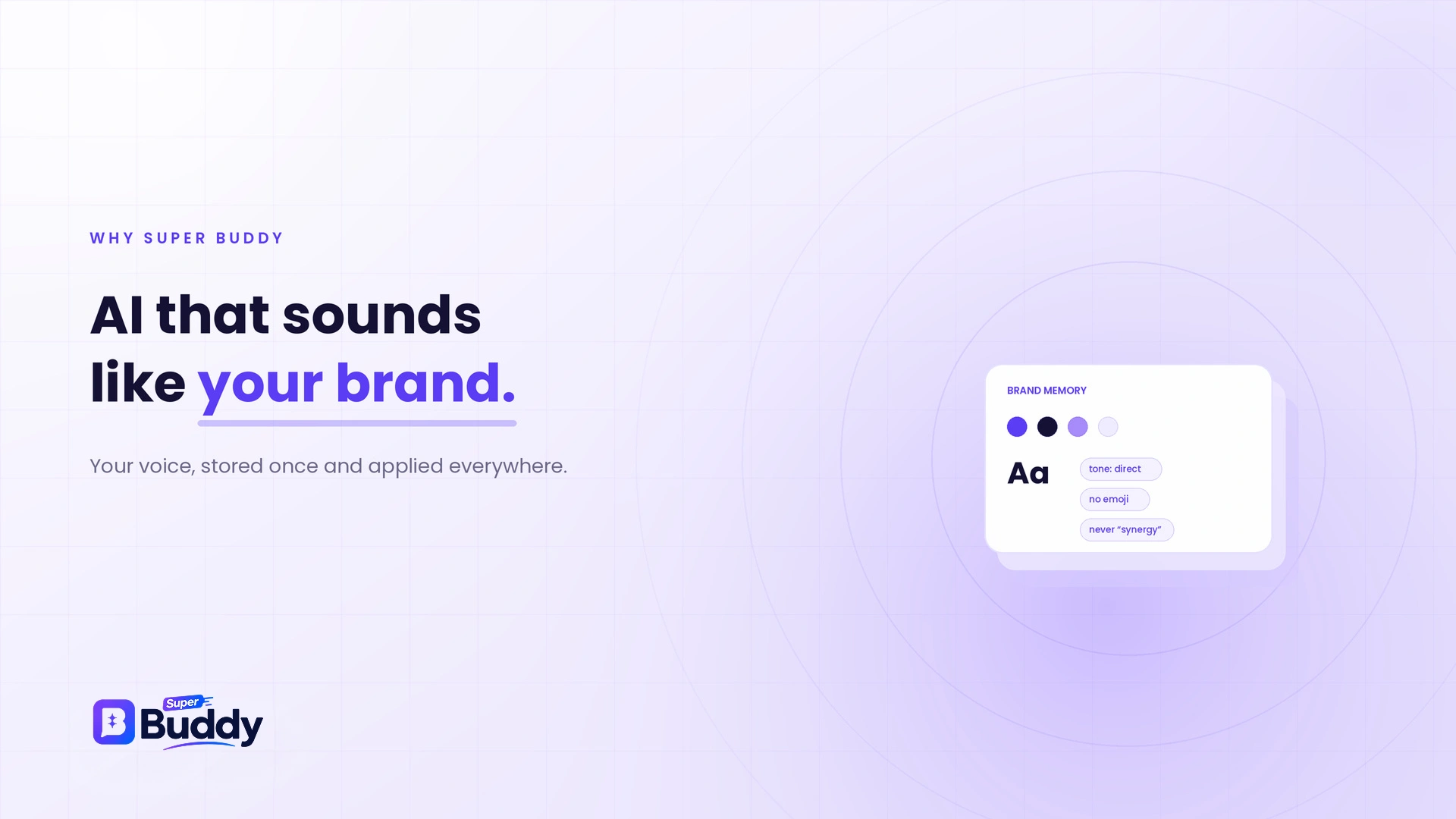
Super Buddy is built the other way around. Brand Pulse Memory is the always-on brand brain: it learns your voice, stores your visual rules, and enforces both across captions, visuals and replies. You teach it once instead of re-explaining yourself in every prompt.
Everything else in the product sits on top of that layer. Content generation, scheduling, the inbox and analytics all draw from the same brand memory, which is why output stays consistent as volume grows.
Why most AI social tools sound the same
Three things produce generic output, and none of them are fixed by writing longer prompts.
- No memory between sessions. Without your published archive, a model falls back on the safest phrasing available, which is phrasing that would suit any company in any industry.
- Broad tuning. The same model serves a local plumber and an enterprise software company, so it is deliberately tuned to be acceptable to everyone. Acceptable to everyone is another way of saying generic.
- Description instead of demonstration. A style guide tells a model what your voice is supposed to be. Your actual posts show it. Those are different inputs, and only one of them reliably works.
Super Buddy addresses the third point directly. You feed it real published content, not a description of how you would like to sound.
How Brand Pulse Memory works
The concept is simple enough to explain without jargon. The system reads examples of how your brand already writes, then produces new content that matches the pattern.
- Learns your voice. Feed it past posts and it captures your tone, phrases and rhythm, then writes everything to match.
- Stores your rules. Colours, fonts, banned words, emoji policy and formatting preferences are saved once and applied everywhere.
- Keeps everyone consistent. Teams and agencies get one shared brand memory, so five people posting still sound like one brand.
- Separates multiple brands. Each brand or client keeps its own memory, and the voices never mix.
The banned words and emoji policy settings matter more than teams expect. Telling a system what you never say sharpens voice faster than describing what you do say, because it removes the specific phrases that make output read as machine-written.
Voice is only half of it
Brand consistency is not only a writing problem. A post can be worded perfectly and still look like it came from a different company.
Super Buddy applies the same stored rules to visuals. On-brand visuals generate post images and multi-slide carousels using your colours, fonts and visual style, sized correctly for each platform rather than cropped after the fact.
That pairing is the point. The caption sounds like you and the graphic looks like you, produced in the same workspace, from the same brand memory, without a handoff between a writing tool and a design tool.
What consistent brand voice actually buys you
Voice consistency gets treated as brand hygiene. It has practical returns.
- Recognition compounds. Audiences build familiarity with a tone over months, and consistent brands need fewer impressions to be remembered. Inconsistent ones restart that recognition every time they post.
- Review time drops. When drafts arrive on voice, editing becomes a check rather than a rewrite. That is usually where the real time saving in AI tooling comes from, not from generation speed.
- Onboarding gets faster. A documented voice sits in a file nobody opens. A trained voice applies itself to the new hire's first draft.
There is a simple test for whether yours is working. Remove your logo from a post and show it to a regular follower. If they still know it is you, the voice is doing its job.
What you get in one workspace
Super Buddy folds the whole content loop into a single surface. The AI social media management features cover:
- Caption and copy generation for hooks, captions and calls to action in your voice
- Hashtag intelligence that mixes trending, niche and branded tags per post
- On-brand images and carousels generated from a prompt or an existing caption
- A social media scheduler that auto-queues each post at the time your audience is most active
- A content calendar with drag-and-drop planning and approvals in one view
- A unified inbox that pulls comments and direct messages into one thread
- A repurposing engine that turns one post into a week of content
- Engagement analytics covering reach, saves and follower growth
- An AI reels script generator, currently listed as coming soon
Publishing runs through social media integrations with Instagram, TikTok, LinkedIn, X, Facebook, YouTube, Pinterest, Threads and Google Business, connected over official APIs.
Why this matters more for teams
A solo creator carries the brand voice in their head. A team cannot. The moment a second and third person start drafting, voice stops being a personal instinct and becomes an operational problem.
Shared brand memory is what solves it. New writers inherit the voice by default instead of learning it through six months of edit rounds. Social media solutions for marketing teams add the surrounding structure: campaign planning on a shared calendar, roles and permissions so writers draft while managers publish, and performance insights everyone can see.
Agencies face the sharper version of the same problem, since every client is a different voice and mixing them is a client relationship issue, not just an aesthetic one. Agency social media management keeps each client in a separate workspace with its own brand memory, approval flow and white-label reporting.
Super Buddy at a glance
| Job to be done | What handles it | What it draws from |
|---|---|---|
| Writing captions | Caption and copy generation | Your stored brand voice |
| Designing posts | On-brand visuals | Your colours, fonts and style |
| Choosing hashtags | Hashtag intelligence | Trending, niche and branded mix |
| Publishing | Social media scheduler | Best-time auto-queue per platform |
| Responding | Unified inbox | Comments and DMs in one thread |
| Measuring | Engagement analytics | Reach, saves, follower growth |
| Scaling a team | Roles, approvals, shared memory | One brand voice across writers |
Read this as a summary of how the pieces fit rather than a competitive scorecard.
Who Super Buddy is built for
- Marketing teams that need several writers to sound like one brand
- Agencies managing multiple clients with voices that must stay distinct
- Startups and small businesses without headcount for a content team
- Content teams at volume, where consistency slips before quality does
- Multi-brand companies running separate identities from one place
- Teams publishing across many platforms who are tired of reformatting by hand
If you publish occasionally, from one account, and you write everything yourself, a simple scheduler is probably enough. Super Buddy earns its place when voice has to survive scale.
How to get started
- Connect your accounts. Link Instagram, TikTok, LinkedIn, X and the rest in a couple of clicks over official APIs.
- Teach Super Buddy your brand. Feed it past posts, set your colours and fonts, and add the words and emoji rules you want enforced.
- Generate a batch. Produce captions, hashtags and visuals, then edit them the way you normally would.
- Schedule and publish. Queue everything on one calendar and let the scheduler place each post at the best time.
Setup takes about two minutes and the trial runs for 7 days with no credit card required. Current plans are on the pricing page.
Bottom line
The useful question when choosing an AI social media tool is not how much AI it has. Nearly every platform has some now. The question is whether the AI remembers who you are between sessions.
Super Buddy is built around that answer. It learns your tone, colours and rules once, then applies them everywhere, so every post still sounds and looks like it came from your team even when the system wrote the first draft.
Try Super Buddy free
Turn one idea into a week of content. No credit card required.